


MILK FROG UNIVERSITY / NATURE & EVERYDAY LIFE
The Pond Nature Atlas
Turn a passing glance into a closer look. Leave a careful, gentle record of the leaves, water and small lives around the campus pond.
Read the working materials
- Project reference
- MFU-NAT-001
- Current stage
- Observation template · Published
- Participating schools
- School of Nature & Life Sciences × School of Design & Everyday Life
- Record updated
START WITH A QUESTION
What do we want to understand?
How can we record changes around the pond so that someone else can understand them, without disturbing the life already there?
An atlas does not need to name every leaf at once. We begin by separating what we can see from what we think it might mean: location, shape and change come first, with room for uncertainty. Nature & Life Sciences frames the observations; Design & Everyday Life makes the records easier to read.
The project starts with an observation card and an atlas label. They can support a Milk Frog campus story or provide a structure for a personal nature journal. Each record keeps its conditions and open questions alongside the description.
HOW WE APPROACH IT
Make the process visible.
Observe from one place
Choose a position on an existing path. Record the direction you face and the observation period. Keep your distance, leave plants and small animals undisturbed, and note anything you cannot see clearly.
Separate observation from inference
Put colours, shapes and movement under direct observation; put possible explanations under questions to check. Describe an unfamiliar species by its appearance instead of guessing a name.
Check words against drawings
Use a simple sketch to mark the area observed, then check that each description matches it. Keep the conditions and unresolved questions on the label alongside the image.
PROJECT STAGES
Keep a record of each step.
Prepared · Question framework
Agree on how to record
Define the observation card and separate direct observations, possible explanations and questions for another visit.
Published · Working materials
Start with one card
The template and creative example below are available for individual practice or a shared course project.
Next · Collaborative proposal
Build a small atlas
Invite campus nature notes in a shared format, then discuss how the labels should be arranged and read.
OPEN WORKING MATERIALS
A starting point for your own exploration.
Read, take notes and adapt these project examples.
MATERIAL 01
Pond observation card · Blank template
Copy these five prompts into a journal. Write “not observed” where appropriate; every blank does not need an answer.
01 Conditions | Date and time: ____; location and direction: ____; weather and light: ____; distance and duration: ____. Keep comparable conditions when you revisit the same place.
02 Direct observation | Colours, outlines, actions or changes in position: ____. Start with a specific description, such as “a widening ring on the water”, before deciding whether a name is needed.
03 Visual record | Sketch the observation area and mark the position of leaves, water or the bank. Image source: ____; maker or photographer: ____; useful text description: ____.
04 Possible explanation | My guess: ____; observation supporting it: ____; what remains uncertain: ____. Keep guesses here instead of mixing them into the factual description.
05 Another visit | Conditions worth revisiting: ____; another comparison to make: ____; areas where distance should be maintained: ____.
MATERIAL 02
Atlas label · A curling lotus leaf
A fictional campus writing example showing how observation, interpretation and uncertainty can share one label.
Title | A curling lotus leaf. Location | The east-side pond path, facing the water. This is an invented scene with no field observation date.
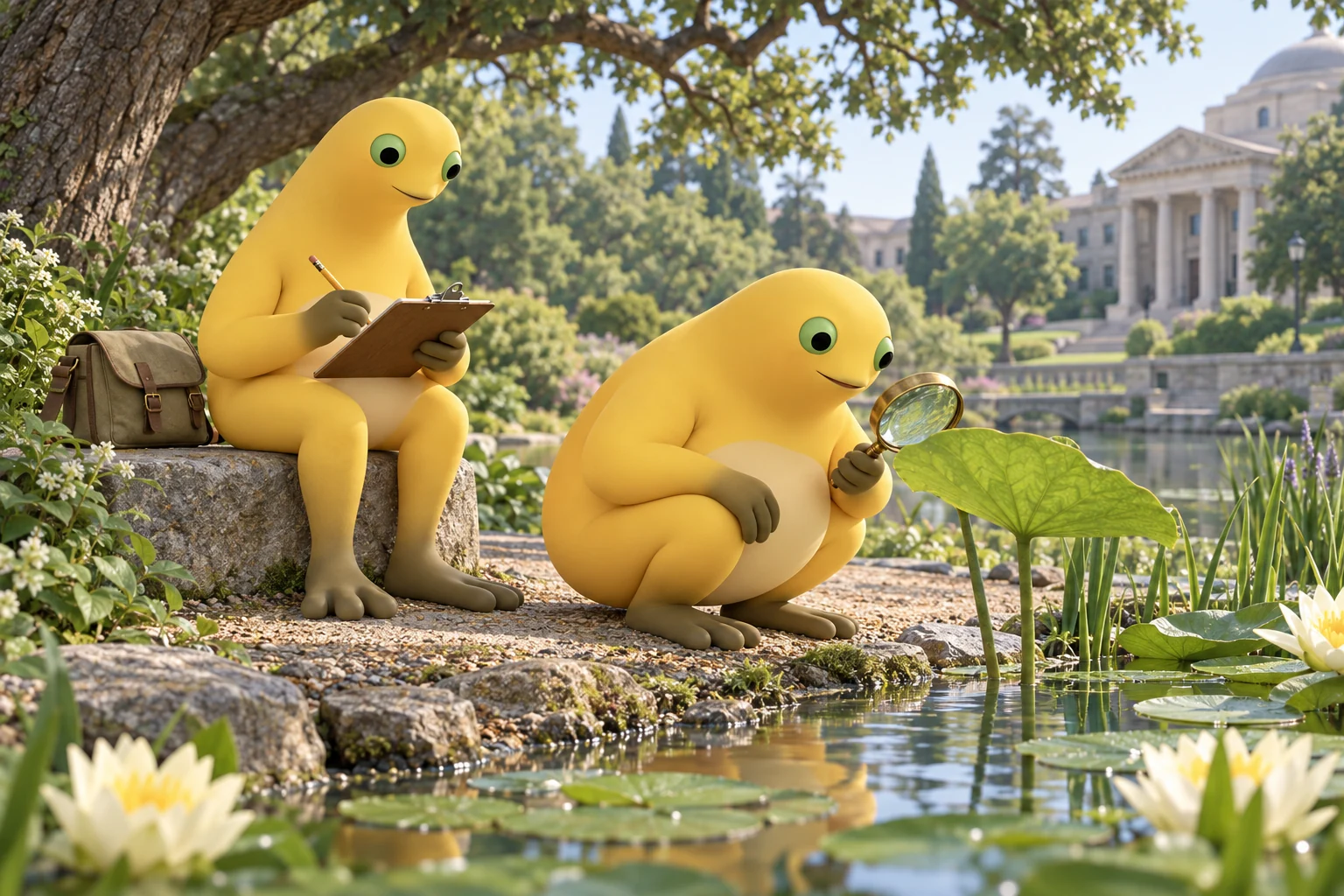
What the illustration shows | A round leaf rises above the water, with its right edge curling upwards. Its shadow falls to the lower right; small ripples cross the surface. The description stays with details visible in the imagined illustration.
A possible explanation | The curl might relate to the leaf's condition or to wind within the scene, but one picture cannot establish this. The label does not turn the guess into a conclusion about plant growth.
For the next observer | What other textures might appear under different light? Draw a second view and add a sentence or two explaining how it differs from the first.
WORKING ACROSS SCHOOLS
Bring different questions together.
Learning hostDreamer
School of Nature & Life Sciences
Begin with a lotus pond on campus. Observe the details of living things, discover ecological connections and seek ways to build a more resilient home for all.
Explore this school · School of Nature & Life Sciences
School of Design & Everyday Life
Good design begins with careful attention to everyday life. From a drinking cup to a campus path, use creativity to respond to real needs, however small.
Explore this school · School of Design & Everyday Life