


MILK FROG UNIVERSITY / CULTURE & EXPRESSION
Milk Frog Expressions & Campus Stories
How many ways can one Milk Frog say “I understand”? From a short caption to a campus story, explore how a little humour can reach another person.
Read the working materials
- Project reference
- MFU-CUL-002
- Current stage
- Expression examples · Published
- Participating schools
- School of Humanities & Creative Arts × School of Digital Culture & Communication
- Record updated
START WITH A QUESTION
What do we want to understand?
Why does the same Milk Frog expression tell a different story when its words or context change?
An expression is more than a face. Its timing, caption and the relationship between people all matter. Humanities & Creative Arts examines the image and story; Digital Culture & Communication explores context and interpretation. Together, they turn “that looks funny” into a set of choices we can discuss.
The project uses original campus scenes as exercises. State the intended meaning, consider another possible reading, then check whether more context is needed. The examples keep this editing process visible behind a light-hearted expression.
HOW WE APPROACH IT
Make the process visible.
One image, different words
Keep a Milk Frog gesture fixed and try a personal remark, a reply and a narrator's line. Compare the point of view each creates and the background it needs.
Change the context
Place the same words in a close-friends chat and in a newly formed class group. List possible differences in interpretation as editing hypotheses, without treating them as audience findings.
Try a four-panel story
Build a scene through a starting situation, an expectation, a turn and a response. Check each character's motivation and let humour come from everyday circumstances.
PROJECT STAGES
Keep a record of each step.
Prepared · Analysis framework
Look at each part
Organise the discussion around visual cues, captions, context and possible ambiguity.
Published · Creative examples
Leave the choices on the page
Read one caption comparison and one four-panel script, each with questions for further revision.
Next · Editing exercise
Collect other readings
Invite alternative captions and explanations, keeping versions side by side before discussing where each might work.
OPEN WORKING MATERIALS
A starting point for your own exploration.
Read, take notes and adapt these project examples.
MATERIAL 01
Expression analysis · Thinker and an open book
One image, three captions. These interpretations are creative hypotheses to compare and revise.
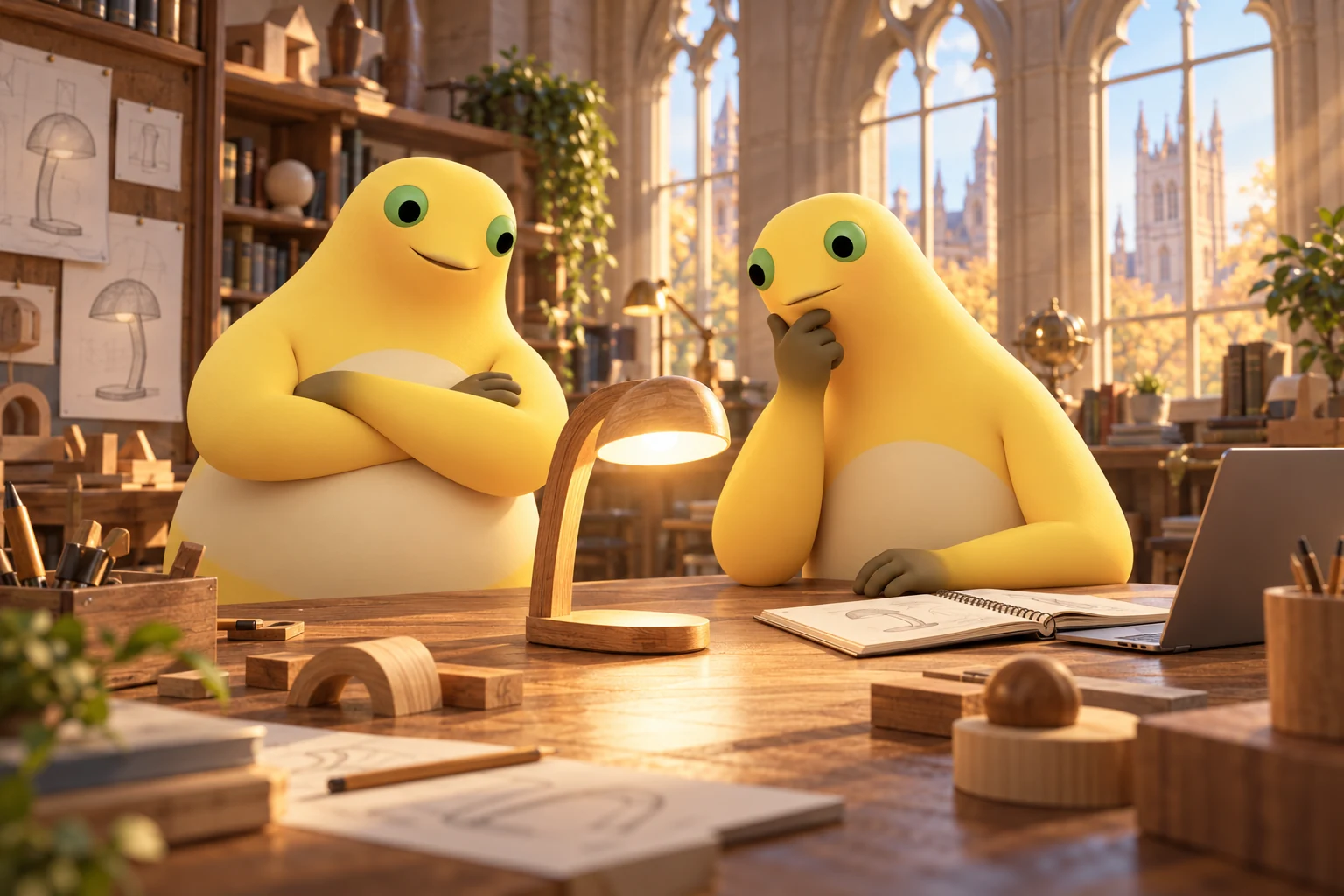
Fixed image | Thinker sits before an open book, one hand supporting their face and their gaze resting near the page corner. The image alone does not tell us whether they are concentrating, daydreaming or waiting for someone.
Version A: “This question and I are still getting acquainted.” | A difficult task becomes a first meeting. In a personal study note, it may suggest a relaxed pause to think. Sent to someone asking for help, it might seem to leave their request unanswered.
Version B: “I'm listening. Take your time.” | The same pose becomes an act of listening. The scene needs a conversation partner; without one, a reader might still interpret the gaze as distracted.
Version C: “The library breeze turned the answer to the next page.” | A narrator gives the scene a poetic opening. The caption leaves the character's feelings unstated, allowing the next panel to show them through action.
Editing questions | Who is speaking, and to whom? Does the line still make sense without the previous message? Add a use case for each version, then invite another reader's first impression and record differences without deciding on a single correct answer.
MATERIAL 02
Four-panel script · The first mark of the day
An original script that turns a delayed start into a small moment of encouragement between friends.
Panel 1 — The start | Doer lays out a fresh sheet and writes, “Today: one masterpiece.” Thinker asks from across the desk, “Where will the first mark go?”
Panel 2 — The expectation | The paper is still blank. Doer has tried holding three different pens. Caption: “First, choose the most inspiring pen.”
Panel 3 — The turn | Companion moves a cup, revealing a tiny dot near the edge of the paper. “You've already started here.” It is a mark left while testing a pen.
Panel 4 — The response | Doer adds a lotus leaf beside the dot. “Then we'll start with one small drop of water.” All three look at the page, leaving space for the drawing to continue.
Revision exercise | Remove the caption in panel 2 and use only actions to show hesitation. Then give the last panel a campus line of your own. Keep both versions and your reasons for changing them, and compare their emotional effect.
WORKING ACROSS SCHOOLS
Bring different questions together.
Learning hostThinker
School of Humanities & Creative Arts
Turn what you feel into something others can share. Through images, stories and public art, explore the connections between people and the world around them.
Explore this school · School of Humanities & Creative Arts
School of Digital Culture & Communication
From Milk Frog's belly laugh to the digital routines of young people, explore why culture catches on and how playful expression brings different people together.
Explore this school · School of Digital Culture & Communication